

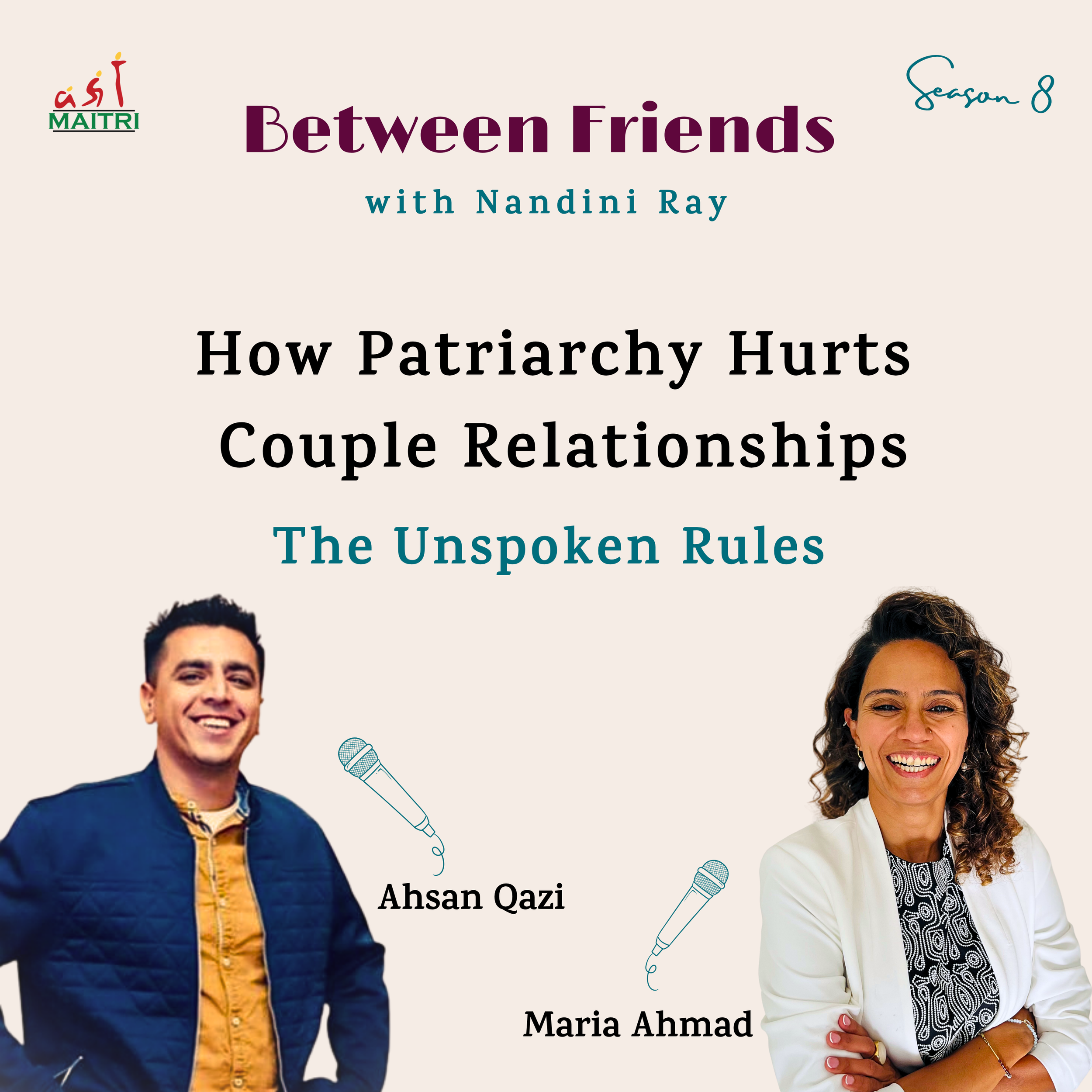
S8 Ep1: How Patriarchy Hurts Couple Relationships
How do harmful cultural norms, traditions, and deeply rooted beliefs impact intimate partner relationships—and what can we do to change them?
To help us unpack this important topic, our host Nandini Ray was joined by two distinguished members of the Pakistani community: Ahsan Qazi and Maria Ahmad.
Ahsan Qazi is a writer, researcher, entrepreneur, and sociologist with a deep interest in understanding the forces that shape society. Ahsan has a bachelor’s degree in English Literature and Sociology, followed by an MBA in Strategy and Innovation. He is the founder of One Voice: Pakistan and World Affairs in Sociological Perspective. Ahsan has written extensively on social, political, and global issues, with his work published in Eurasia Review. His research explores inequality, governance, identity, and the growing impact of artificial intelligence on society, political beliefs, and human behavior. Professionally, he has spent more than eight years working in enterprise technology and technical communication, and he is the founder and CEO of Marvalero, where he is building an AI-powered platform for businesses and creators. While technology is an important part of what he does, his deeper passion has always been understanding people, how societies evolve, why institutions succeed or fail, and how ideas shape civilizations.
Maria Ahmad is an international development professional with two decades of experience working at the intersection of gender, migration, and institutional accountability across UN agencies, INGOs, and independent consultancies. Her work has repeatedly returned to the question of how women — particularly migrant and minority women — are represented, protected, and structurally excluded within the systems meant to serve them, from her early reporting career in Pakistan as an award-winning journalist covering social and gender issues - including reports on Mukhtara Mai’s jirga-approved gang rape and accompanying her to Pakistan Parliament to fight for justice - to her recent gender-mainstreaming review of Uruguay’s National Migrant Integration Plan with UN Women and IOM, where she examined how policy frameworks fail to account for gender even when they claim to be gender-responsive.
Maria’s career began in journalism in Pakistan, where she reported for GEO TV, BBC Radio, and Canadian broadcasters before moving into humanitarian and development work with IOM, where she spent years designing accountability and communication systems for displaced and vulnerable populations, including large-scale crisis response in Pakistan. She has since worked on safeguarding frameworks addressing gender-specific vulnerability and trafficking risk, advised on AI-enabled tools for documenting technology-facilitated gender-based violence, and written on the representation of immigrant communities in public discourse. As a Pakistani woman who has lived and worked across South Asian, Middle Eastern, and Latin American contexts, she brings both a personal vantage point on the patriarchal norms shaping South Asian family and partner relationships, and a professional lens on how those norms show up — often invisibly — in the policies and institutions built around them.
Nandini Ray is the Sr. Manager, Outreach, Prevention & Policy Advocacy at Maitri. (E) nandini@maitri.org Visit: www.maitri.org Follow @maitribayarea on Facebook, IG, and LI.